
Are You Creating Your Life or Reacting to It?
It's a simple question, but it can hit hard. For most women in midlife, the honest answer is reacting. Not because you're doing anything wrong, but because there's just so much coming at you at once.
A Day Spent in Reaction Mode
See if any of this sounds familiar.
You step on the scale and your whole mood for the day is decided in about two seconds.
A hot flash hits in the middle of a conversation, and you're suddenly fanning yourself, flushed and distracted, hoping no one notices.
You wake up after another rough night and start the day already running on empty.
Then there's your boss. Your kids. Your aging parents. Your husband, gently asking what's wrong, when you honestly don't know how to explain it because you're not sure yourself.
By mid-morning, your nervous system feels like it's trying to keep seventeen different plates spinning in the air at once. Every new demand gets a reaction, because there isn't any room left for anything else.
This isn't a character flaw. It's what happens when a body and brain are stretched past capacity for too long. Living in reaction mode is exhausting, and it can quietly start to feel like the only way to live.
The Quick-Fix Chorus
And then, right when you're at your most tired, the advice starts rolling in.
"Just take the GLP-1."
"Just start HRT."
"Take this supplement."
"Have you tried this peptide?"
It comes from friends, from social media, sometimes from well-meaning professionals. Everyone seems to have a quick answer for a problem that doesn't feel quick at all.
And maybe part of you nods along. But another part of you, the quieter one, thinks: that can't be the whole answer.
I want to be clear here. Some of those tools may have a place, and any decision about medication or hormones belongs in a conversation with your doctor.
But if you've always believed in doing things as naturally as you can, if you want to understand the root cause of what's happening, and if you don't want to spend the next decade depending on more and more outside interventions just to feel okay, then that quieter part of you deserves to be heard.
It isn't being stubborn. It's asking a better question.
Your Symptoms Aren't Random
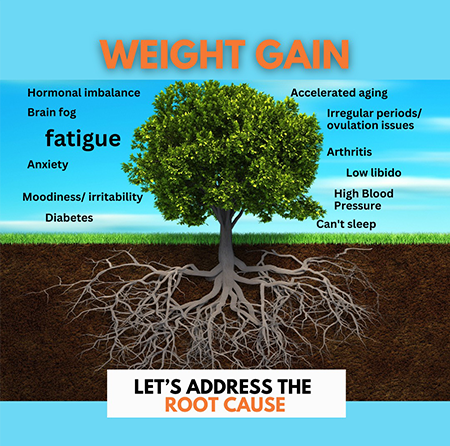
Here's what I've come to believe after years of working with women in midlife. Your body is giving you information all the time.
The weight that won't shift. The fatigue that coffee can't touch. The anxiety that shows up for no clear reason. The poor sleep. The brain fog. The bloating. The hot flashes.
It's easy to see these as random inconveniences, a frustrating list of things that just happen to women at this age. So you manage them one by one. Something for sleep, something for bloating, something for your mood, a new plan for the weight.
But they aren't random. They're clues.
When you start looking at them together instead of one at a time, patterns begin to show up. Your metabolism, hormones, stress response, and nervous system are deeply connected, so strain in one area rarely stays there. A body that's been under chronic stress and running on blood sugar highs and lows is going to tell you about it, and it usually won't use just one symptom to do it.
That's why chasing each symptom separately can feel like playing whack-a-mole. You push one down, and another pops up somewhere else.
What Changes When You Understand the Clues
This is the part I love, because it's where things start to shift.
When you begin to understand what your body's clues might mean, you stop feeling so powerless. Symptoms that used to feel scary or confusing start to make a little more sense. You're no longer standing in the middle of the storm wondering what hit you. You have context.
And with context, you can start working with your body instead of fighting it.
That one change ripples outward in ways that surprise a lot of women.
It changes your confidence, because you're no longer guessing or second-guessing. You know why you're making the choices you're making.
It changes your energy, because you stop pouring effort into approaches that were never designed for what your body actually needed.
It changes your decisions. What you eat, how you rest, what you say yes and no to, who you ask for help. When you understand yourself better, those decisions come from clarity instead of panic.
And that's when life starts to move differently. Not overnight, and not perfectly. But noticeably.
You Don't Need Another Quick Fix
If you've tried the diets, the programs, and the products and you still don't feel like yourself, I want you to hear this: it's not because you didn't try hard enough.
You don't need another quick fix. You need to understand what your body is asking for.
That's exactly why the first step I offer is about clarity, not commitment.
With the Body Compass, you complete a Blood Work Analysis, and then we meet one-on-one on Zoom for 30 minutes. We look at your results alongside your symptoms and start piecing together what your body may have been trying to tell you.
We'll also talk honestly about whether the Metabolic Hormone Reset is the right fit for you, because it isn't the right program for every woman, and I'd rather you know that up front.
Not ready for a call yet? The free Body Type Quiz is an easy place to start listening.
Take the short quiz to reveal your Body Type and what this means for your weight and health goals.